Guide · Finding customers
Outbound sales without an SDR: how solo founders find and email their first customers
Outbound sales without an SDR means you are the one who finds the people, writes the first email and answers the replies, in the hours left over from building the product. This guide is about doing that without it eating the week: deciding who to write to, what each option really fixes, and where software that searches and writes belongs in the list.
In this guide:
- Why outbound stalls when you are the whole sales team
- Decide who you are selling to before you look for anyone
- The options, honestly: by hand, bought data, a hire, your own automation, AI search
- What the first email has to do
- Hire an SDR, or let software do the first email?
- Where AI lead search fits
Updated
Why outbound stalls when you are the whole sales team
It is rarely a lack of nerve. Outbound stalls because each lead costs an hour you do not have: find a business that might fit, read enough of their site to know, hunt for a named person and an address, write something that is not a form letter. Do that ten times and the afternoon is gone, and a customer email or a bug has been waiting the whole time.
So founders reach for shortcuts that look like outbound. A bought list goes stale in the sheet. A blast from a template gets a reply from nobody and a spam flag from someone. A tool wired together on a Sunday breaks on Tuesday. The common thread is that the finding and the writing were skipped, and those were the whole job.
The real cost is that outbound only ever happens in the gaps, so it never becomes a habit and never produces enough replies to learn from. The rest of this guide is about changing that, with or without software.
Decide who you are selling to before you look for anyone
Every option below, including hiring, is only as good as this page. Write four lines before you open LinkedIn, a database or a search box. If a line is vague, the emails will be too.
The kind of business
Not an industry name, a sentence. “Independent bike shops with an online store” beats “retail”.
The person who decides
The role that would reply to your email and could say yes without a meeting about it. For a small business that is usually the owner.
A sign they have the problem
Something visible on their website or in a directory: they sell online but have no chat, they list a phone number but no booking page, they are hiring for the job you replace.
The one problem you solve for them
In their words, not yours. This line becomes the first sentence of every email, so it is worth an hour.
The options, honestly
Five ways one-person companies do outbound, with what each one fixes and what it leaves to you. They stack: almost everyone starts by hand, and the other four are ways of buying back the hours once you know what works.
| Option | What it fixes | What it does not fix | When it fits |
|---|---|---|---|
| Prospect by hand | Fit. You read each website, so every lead is one you chose, and the email you write knows something true about them. | Time. Reading, finding the address and writing one real email is slow, and it is the first thing dropped when a customer or a bug needs you. | Your first batch, always. You learn who replies, and that lesson is what every other option is built on. |
| Buy a list or a database subscription | Volume. Thousands of names with job titles and company sizes, filtered in minutes. | Fit and freshness. The filters know the title, not whether this business has your problem. Addresses go stale as people move, and vendors usually sell access as a subscription for each person using it. | When your buyer is defined by a job title at a company of a certain size, and you have the hours to qualify the list before you write. |
| Hire a freelance SDR or an agency | Hours. Someone else does the finding and the first email while you build. | Knowledge. They do not know your product or your customer yet, so you write the playbook anyway, and the first emails sound like a stranger’s. Hard to judge results for months. | When you already know who buys and why, and the finding and writing is a repeatable job you can hand over. |
| Wire your own automation (n8n, Make, scrapers) | Repetition. Scrape a directory, enrich, push to a sheet, send through a mail tool, on a schedule. | Your evenings. Every site change breaks a step, and the result still has to be written by someone or by a template. | Technical founders who enjoy it and have a stable source of leads to point it at. |
| Software that searches the web and writes the first email | Finding and the first draft. It reads your website, searches public pages for businesses that fit, and writes one email per lead from their page and yours. | The conversation. It cannot take the call, and its addresses are not verified. It can also be wrong, so you read before you trust it. | One person, a clear idea of who buys, and no hours for the searching. Growth happens when the replies start. |
The last row is what ReachClaw does; how the search and the writing work is explained on the AI lead generation page. The other rows need nothing from us.
What the first email has to do
Whoever writes it, you or software, the first email has four jobs. Judge every draft against them before it goes out.
Job 1
It is about them
The first sentence names something true about their business, taken from their own website. If you cannot find one, they are not a lead yet.
Job 2
One ask
A reply, a yes or no, a look at one page. Not a deck, not a meeting, not three links. Short enough to read on a phone between two other emails.
Job 3
From your real address
A founder writing from their own Gmail is the one advantage you have over a sales team. Do not give it up for a sending domain nobody has heard of.
Job 4
Easy to say no to
Say who you are, why them, and give a one-click way out. The people who were never going to buy leave quietly instead of marking you as spam.
Volume comes last. Gmail stops you for a while when you pass its daily sending limit, and the limits are on Google's own sending limits page; a batch small enough to read every reply is the right size anyway.
Hire an SDR, or let software do the first email?
The answer is in where your hours actually go, not in a salary comparison. A person and a piece of software are good at different parts of the job. Work-Bench's playbook on founder-led sales before hiring makes the same point from the investor's side: founders who hire outbound reps too early have nothing repeatable to hand them.
The bottleneck is finding people and the first line
You know who buys and what to say; you just never get to it. This is the part software does: search, save the lead with the page it came from, write the first email from their site and yours. You read and approve, then answer the replies.
The bottleneck is the conversations
Replies are coming and you cannot keep up with calls, demos and objections. That needs a person, and for a while that person is you, because nobody else can answer the hard question yet. An SDR or a part-time closer comes after the answers are written down.
You do not yet know who buys
Neither. Hiring now means paying someone to learn it slowly; automating now means reaching the wrong people faster. Write a small batch by hand, see who replies, and fix the four lines of your worksheet first.
Where AI lead search fits
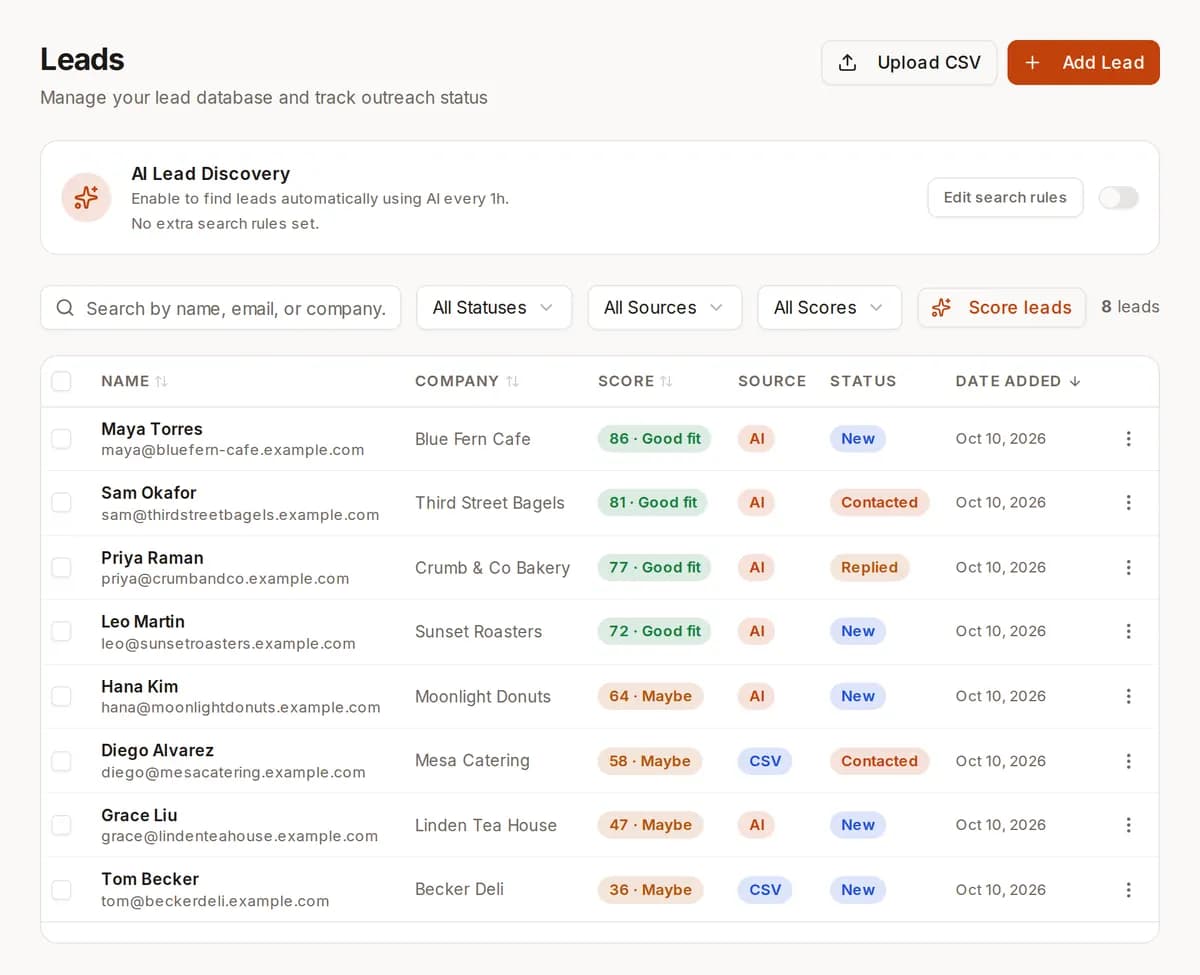
This is the part ReachClaw does, so here it is in the same plain terms as the rest of the list. You connect the Gmail you send from and give it your website. It reads your pages, documents and notes and builds a picture of who you sell to: the kinds of business, the roles, the problems. You cannot type that profile in by hand today, but you can give the search written instructions and block domains, company keywords and whole industries.
Then it searches public web pages for businesses that fit. It is told to keep only people whose email address is visible on a page it read, to skip generic info@ and hello@ addresses, and to save each lead with name, role, company, the page it came from and a note on why it fits. Addresses are not verified, duplicates are skipped, and a found lead has no score until you ask for one from the Leads page.
For the email, you pick a template, your own or one it wrote from your pages, and it drafts one email per lead from that template, the lead's site and yours. In a one-time campaign the drafts wait for you: approve each one or all of them, then they send from your Gmail with an unsubscribe link. An ongoing campaign runs again on the interval you set, looks for new leads if you left search on, writes an email to each lead found or added since the last run, and approves and sends them itself until you pause it or it reaches an end date you set. Nobody gets a second email for not replying.
What it does not do matters as much. It sends one email per lead, no follow-up sequence. It does not verify addresses, enrich records or sync to a CRM. It cannot take the call. It shows you opens, clicks and replies per lead, filters out the opens that are email scanners rather than people, and when someone writes back the reply lands in your Gmail where ReachClaw can draft the answer like any other email. It runs on your own Anthropic API key, billed by Anthropic.
Every paid plan is one flat price, from $6.99 a month on Solo with 100 outbound emails a month. Growth is 500 a month and Scale has no cap. The step-by-step version, from website to sent email, is our guide to automating lead generation. If support email is the other half of your inbox, the same plan covers it; our guide to customer support for solo founders is this page's twin.
Keep reading
AI lead generation, explained
What it is, how the search and the writing work, what it costs and what stays yours to do.
Automated lead generation, step by step
From your website to a sent email: the stages, the mistakes, and what stays manual.
Best AI lead generation tools
ReachClaw next to Apollo, Clay, Instantly, Lemlist and others, with starting prices.
Plans and prices
Solo, Growth and Scale, one flat price each, and the outbound caps that come with them.
Questions solo founders ask about outbound
How do solo founders do outbound sales without an SDR?
The ones who make it work decide exactly who they are selling to, write a small batch of emails by hand to learn what gets a reply, and only then hand the finding and the first email to software or to a person. The founder keeps the conversations: the replies, the calls, the objections. An SDR is a way to buy hours for the finding and writing; software is a cheaper way to buy the same hours, as long as you still read what it writes.
How long does it take to build a lead list by hand?
We do not publish a figure, because it depends entirely on how hard your buyer is to find. Measure your own: set a timer for one hour, find as many businesses as you can that fit all four lines of your worksheet, and note how many had a named person with a visible email address. That number is your real cost per lead in hours, and it is the number to compare every other option against.
Is buying a lead list worth it?
It is worth it when your buyer is defined by a job title and company size, because that is what databases filter on. It is not when your buyer is defined by a problem you can only see on their website, because no filter finds that. A bought list also arrives without the one true sentence each email needs, so the writing is still ahead of you. AI lead search looks for the sign of the problem on public pages instead, and saves the page it found each lead on; neither route verifies addresses. Our Apollo.io alternative page compares the two in more detail.
How do I do cold outreach when I am a one-person company?
Send from the address you actually use, to a small number of businesses you chose, with one true sentence about each and one ask. Say who you are and give a one-click way to opt out. Stay inside Gmail's own sending limits, and judge a batch by replies, not by how many you sent. The things that get a one-person company marked as spam are the same things that make a sales team look like one: bought lists, a new sending domain, a wall of links. Our outbound lead generation page covers the spam-folder question.
How do people personalize cold emails at scale?
Three ways, in order of effort. Templates with fields: the name and company change, the rest is the same, and readers can tell. Writing each by hand: the best emails, at the cost of the hours this guide is about. Software that writes each email from the lead's public page and your own pages: ReachClaw does this, drafting one email per lead from its template, the lead's website and what your site says, so the first sentence can be about them. Read the first batch before you trust it.
Do I need an SDR to do outbound?
Not to start, and hiring one before you know who buys usually means paying someone to find that out slowly. What an SDR does that software does not: takes calls, qualifies on the phone, handles objections, and keeps a conversation going over weeks. If those are your bottleneck, a person is the answer. If the bottleneck is finding people and writing the first email, software covers it for a fraction of a salary, and you stay the one who answers.
Where does AI lead search get the email addresses, and are they verified?
From public web pages. ReachClaw's search is told to keep only people whose email address is visible on a page it read, to skip generic info@ and hello@ addresses, and to save the page it came from, so you can open the source for every lead. It does not guess addresses from name patterns and it does not verify them, so expect some to bounce, and start with a small campaign.
Does ReachClaw send follow-ups if nobody replies?
No. A campaign sends one email per lead. An ongoing campaign runs again on the interval you choose, looks for new leads if you left search on, and emails only the leads found or added since the last run; it never sends a second email to someone who did not reply. Replies land in your Gmail like any other email, matched to the campaign so the lead is marked as replied, and ReachClaw can draft your answer.
What does outbound cost for a solo founder with ReachClaw?
The Solo plan is $6.99 a month, one flat price, with 100 outbound emails a month, one Gmail inbox, AI lead search, campaigns and open, click and reply tracking. Growth is $29.99 for 500 outbound emails a month and 3 inboxes; Scale is $69.99 with no outbound cap and 10 inboxes. The AI runs on your own Anthropic API key, which Anthropic bills separately. There is no free trial; the free account connects Gmail and lets you look around, but it does not search or send.
Two of the answers point elsewhere: the spam-folder question is on our outbound lead generation page, bought data against search on the Apollo.io alternative page, and the 0 to 100 rubric the Score leads button uses is in the free lead scoring calculator.
Read the first leads before you decide
Connect your Gmail, let ReachClaw read your website, and run one search against your four lines. The worksheet costs nothing and works either way.